Building Web Site

  • Subscribe to our RSS feed.
  • Twitter
  • StumbleUpon
  • Reddit
  • Facebook
  • Digg

Tuesday, 10 May 2011

REMINDERS!

Posted on 21:01 by Unknown
The Alexander McQueen Retrospective 'Savage Beauty', is now up at the Metropolitan Museum of Art, NYC. The show opened last week and will run until July. More info HERE.


Also...


The Eowyn and Nazgul Challenge ends this Sunday! That's just 4 days to finish up your pieces. Don't forget to submit your pieces to The Art Order for a shot at some prizes.
Read More
Posted in | No comments

Monday, 9 May 2011

Spotlight On: CHRISTOPHER MOELLER

Posted on 21:56 by Unknown
Christopher Moeller is a writer and an artist with numerous graphic novels to his name, including his own Iron Empires: Sheva's War and Iron Empires: Faith Conquers, which he both wrote and illustrated.


Many main-stream comic fans know Chris best for his work on several DC titles, most notably his covers for Lucifer, and the graphic novel 'A League of One', which consists of 102 pages of traditionally painted art. He immediately followed that up with 'JLA Classified: Cold Steel', another DC graphic novel boasting an additional 96 pages of art.


In addition to comics, Chris also works in the gaming industry. He has done numerous illustrations for White Wolf Games, including covers for their Aberrant game books, and miniatures game. He has done illustrations for the World of Warcraft trading card game, did the packaging art for the Axis and Allies miniatures game, and has provided over 100 illustrations for the trading card game Magic: the Gathering.


Over the years, I have grown more and more fond of Chris' work. Painting comics and card art requires a real knack for painting things simply, legibly, and in large part... from your head. Trust me, it's a lot harder than he makes it look! Whether it be males, females, monsters or architecture, Chris seems to excel at it with ease. Bold brushwork and strong silhouettes are trademarks of his style.


Check out more of Chris' work at his website: www.moellerillustrations.com


Read More
Posted in | No comments

Life After Art School: Five Years to An Illustration Career

Posted on 21:01 by Unknown
-By Chris Moeller


The one emotion every newly-minted art school graduate experiences is anxiety. Can I really make it?  What do I do now?  All my friends are getting jobs making $50,000 a year.  Where does that leave me?  I’ll be lucky to get a job delivering pizza.


I graduated from the University of Michigan School of Art back in 1985, ready to take the illustration world by storm.  Until that moment, my life had been mapped out for me.  I had put in my hours painting, drawing from the model, and showing up  at crit time.  Suddenly, I was out in the real world with no more crits, no summer vacation, no spring break, no class-mates.  I wasn’t an upperclassman or a fraternity brother.  I was one of millions of adults, expected to make my way in the world.  Worse, unlike those folks with the $50,000 jobs, I had no clear idea what to expect.  What faced me,  what faces every student who graduates with a degree in the arts, is an undiscovered country that appears shadowy and frightening.


As the years went by, I realized that there was indeed a path through the wilderness, as clear and as straightforward as any law-student’s.  I hadn’t seen it as a terrified graduate, but looking back now it seems obvious.  The first thing to understand is that you’re going to have to pay your dues.  Every starting profession demands this step, even those seemingly wonderful jobs your friends are embarking on.  The hottest law student doesn’t leap right into a partnership, he’s expected to start at the bottom and work his way up.  And prepare yourself, because, for an artist, this step can take time. Embrace the notion that it will take five years before you’re working full time.


FIVE YEARS

I can hear you laughing.  Laughing nervously, perhaps, but, honestly, five years?  When I graduated, I would have laughed right along with you.  I may have felt intimidated by the challenges ahead, but I also felt ready.  I was confident in my skills.  I had been taught what I needed to do to get work as a freelance illustrator.  So, when a successful illustrator named Richard Williams cautioned me that it could take a long time to break in to the business, maybe as long as  five years, I nodded and thought to myself:  “maybe for you, old man, but not for me.”  Over the coming months and years, I had ample time to reflect on his words, and it helped me keep things in perspective.  Five years later, literally, I got my first graphic novel commission, and my career took off.  For those few of you who will get snapped up by a game studio right out of school, give yourself a hand!  Everyone else, take a deep breath and consider the notion that this could take time.  The years immediately after graduation aren’t some horrible purgatory.  They can be some of the most fruitful years of your artistic life.  Give them room to unfold.  Have patience.  Use the time to push hard for what you want, to refine your work and build your confidence.


THE RIGHT KIND OF JOB

First, you’ll need a particular kind of job.  Remember, you’re looking for a JOB not a CAREER.  Keep that distinction clear in your mind.  Optimally, a job should be both part-time, and career related.  The importance of your work being part-time can’t be overstated.  If you’re working full-time, you won’t have the time and flexibility you need for portfolio-building, self-promotion, networking, all of the things you need to do build your career.  There are obviously secondary points to be made here, the most important of which is to live inexpensively.  Think carefully about taking on difficult financial obligations like large student loans, a house, or children.  The leaner you can keep your life during this critical time, the easier it will be to get your career going.  It can be frustrating to see your former school-mates driving expensive cars and living in big houses a few years after graduation, but keep your eye on the prize.  Your path leads to you making a living doing what you love most.


The idea of finding work that builds career-related skills can encompass a broad range of possibilities.  During my 5-years, I did some freelance spot illustrations, painted portraits, and worked in a textile design studio in Manhatten.  In their own way, all of these jobs helped me hone my skills.  The textile design studio was the least directly associated with what I wanted to do, but I was using paint, and I learned everything I know about color-mixing during my years there.  So, if you can get work at a gallery, in a comic-book store, or in a museum, that time is serving a dual-purpose.  If you find yourself working as a waitress or a garbage collector, don’t worry about it.  Every job will teach you important life-lessons, and your job is fundamentally a means to help launch your career.


CAUTIONARY TALE

A friend of mine just graduated with a degree in film-making, and is facing the same uncertainty about the future that you all are.  Rather than get a part-time job, however, he’s chosen to start working full-time as a salesman for an internet company.  He told me that he will feel much more comfortable looking for film work with a year’s earnings in his savings account.  It would have driven me crazy to “take off a year” after graduation.  To my friend, the idea of having no money in the bank is equally unthinkable.  He’s doing what feels he needs to do to move forward with confidence and security.  Though it wouldn’t have worked for me, I support his decision, because I know his strength of character, and because he has a clearly formulated plan.  My warning to him, and to all of you, is that money anxiety is notoriously persistent, no matter how much you have saved.  Odds are, the same anxiety you feel now will still be there a year from now, demanding an extension of the “year off” by one more, and then one more, until you're looking back and wondering when exactly you fell off the train.


SAYING YES

I’m not going to go into the mechanics of looking for illustration jobs.  Hopefully it’s something you learned in school, and if not, the internet is full of helpful advice on building a portfolio, submitting work to editors, etc...  What I want to emphasize is this:  while you’re on your five year plan, look for opportunities, and be prepared to act on them when they appear.  As master illustrator Michael Kaluta told me when I met him at a comic convention in back in 1989: “When you are where I am, you can say no.  Until then, you say yes.”  Prepare yourself to say yes at every moment.  Don’t worry about protecting yourself from unscrupulous publishers, take any job that comes your way.  I know that sounds odd, but unscrupulous publishers are as likely to be your pathway to the promised land as they are to take advantage of you. I started my career painting comics for $60 a page!  In exchange for working nearly for free, I demanded 100 copies of the printed comic to give out as samples (I still have some in my studio).  Carry business cards wherever you go.  Build a web-site and keep it up to date.  Talk to people.  That may seem obvious, but I learned as much from talking to artists during my five years as I did in school.  Go to conventions, and when you’re at them, don’t forget to talk to the artists!  It can be intimidating, but they are some of the friendliest, most helpful people you’ll ever meet.  Trust me, they all walked the path you’re walking right now and they remember how scary it was. Ask them to look at your work.  Ask them about their artwork, and their experiences breaking into the business.  You’ll be surprised how generous they can be.


THE PAYOFF

Twenty-five years ago, I was in school with some incredibly talented students.  I'm only aware of a few that are working as professional artists now.  I’m convinced that most graduates drop out during the years immediately following graduation.  They're stressful years.   It's easy to feel forced by financial necessity into the full-time workplace, putting your dreams on hold.  If you’re serious about wanting to become a professional artist, don’t let that happen to you!  Keep your financial obligations low.  Give yourself time to build your career.  Look for ways to open the door to opportunity, and be ready to jump when that door opens.  In the days ahead, remind yourself that you really are on a path, just like your engineer and lawyer friends.  Their path is eased by fat paychecks and fancy cars.  What you’re aiming for lies farther down the road, but is better than the most expensive car or the biggest house:  a career doing what you love most.  Be brave, be persistent, trust in the process.  Every one of my illustrator friends will tell you:  it’s a life worth fighting for.


Thanks to Chris Moeller for the wonderful guest post today on Muddy Colors!
Read More
Posted in | No comments

Robert Fawcett

Posted on 03:30 by Unknown
by Arnie Fenner


Thank God for small presses; fueled almost exclusively by passion and rarely motivated by profit (which is why I buy from them direct as often as I can as a show of support), the small independent publishers strive to preserve and advance the art form. And in many cases they help promote important creators who might otherwise slip through the cracks of history and into obscurity.


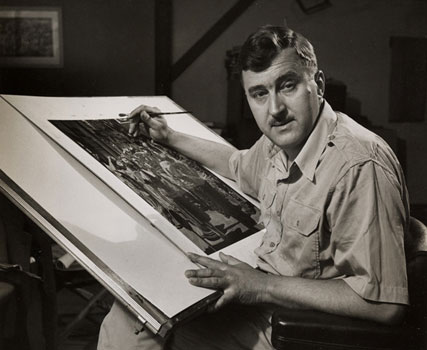
That's why I was extremely happy to get a copy of Robert Fawcett: The Illustrator’s Illustrator from Auad Publishing. Fawcett (1903-1967) was one of the most popular commercial artists of the 1940s and '50s and produced numerous illustrations for The Saturday Evening Post, Cosmopolitan, Colliers, and many other magazines. He used being color blind to his advantage, creating uniquely muted solutions to his work that added to their drama and overall mood. In 1948 he was recruited by Albert Dorne to be a founding instructor of the Famous Artists School and an outgrowth of his teaching was his seminal book On the Art of Drawing. Auad's celebration of Fawcett's life and work is a virtual treasure trove, featuring 250 images, an intro by Walt Reed, and commentary by David Apatoff. Robert Fawcett: The Illustrator’s Illustrator is both a beauty and a bargain.


Read More
Posted in | No comments

Early Art Hero

Posted on 03:09 by Unknown


One of my early art heroes was Robert Vickery. Next to Andrew Wyeth was one of the premiere practitioners of egg tempera. Sadly Mr. Vickery passed away at age 84 in April of 2011. He started out as an illustrator completeing 77 Time Magazine covers before setting off into the world of fine arts. I did get a chance to meet him at group exhibit that I had work in when I was much younger. He was the featured artist. To really appreciate his work you had to see it in person.


Below are a number of links, including a new book on his work that was recently published. His demonstrations in were pivotal in my understanding of the medium of egg tempera. JJP Links: Gallery Obituary: Here You Tube videos: Here and Here Amazon Book Links: Here and Here


Read More
Posted in | No comments

Friday, 6 May 2011

Power of the brushstroke

Posted on 00:08 by Unknown


 By Petar Meseldžija


The painting brush is a simple,  yet powerful device. The trace that it leaves upon the canvas is a wonderful phenomenon - a marvelous present to us, and a precious legacy to the people of the future.


Just as the spoken word that carries a certain energy,  both physical and emotional , so does the brushstroke carry the energy and the meaning, too. By placing the brushstrokes next to each other,  the artist creates a “sentence”. And as any sentence,  whose purpose is to communicate a thought or an emotion, the brushstroke sentences communicate a certain feeling. Therefore they are a perfect vehicle for the artist’s emotions.


The brushstroke is a statement of the artist’s inborn sensibility. It is the reflection of his longings, a trace of his efforts, the emanation of his uniqueness. These are the hidden powers of the brushstroke. Whoever understands that,  and finds the proper way to express it, will not fail to amaze and inspire with his work.


There is a mystery hidden in a spontaneous, and at the same time well guided  brushstroke. The frozen emotion  that is embedded in such a stroke melts in the eye of the spectator, and releases its flavors and fragrances. Avoiding the control of ever alert reason, it penetrates the uncharted areas of our inner space. And as it reaches the level in us that, perhaps, makes us more human than any other aspect,  it touches the cords of emotion, intuition and that mysterious and eternal longing of our soul.


The signature of the artist will stay preserved in the brushstroke almost forever, as the echo of the gone by ages is preserved in a fossil, trapped in the stone.


Such is the power of the brushstroke.


Rembrandt


John Singer Sargent


John Singer Sargent


Joaquin Sorolla


Joaquin Sorolla


Sir Alfred Munnings


Sir Alfred Munnings


Akseli Gallen-Kallela


Akseli Gallen-Kallela


Paja Jovanović


Ilya Repin


Ilya Repin, detail from the painting Portret of V.V. Stasov


Wojciech Kossak


Lucian Freud


James Wyeth


Phil Hale


And now a few humble samples of my own brushwork.


Mother and Child -

70x100 cm (27 1/2”x39 1/4”), oil on canvas, 2001


Saint Georg - 100 x 70 cm / 39 1/4 x 27 1/2 inch,

oil on masonite, 2000


The Balance -

90x120cm / 35 1/2 X 47 1/4 inch, oil on canvas, 2003


Detail from Giants - The Bull Fight, 2010


Detail from The Legend of Steel Bashaw 11, 2005 - 2007


Detail from The Queen of the Kanguellas, 80 X 50 cm / 31 1/2 X 19 3/4 inch,

oil on masonite, 2010


Detail from The Queen of the Kanguellas


Detail from Svjatogor, 2010 


Detail from a painting in progress


This blog post was made possible by the extremely generous and friendly invitation of Dan Dos Santos to join the Muddy Colors “band of blogging brothers”. Needless to say, I am greatly honored by this invitation and I will try not to disappoint, nether my host, nor the audience. Unfortunately, due to my very busy schedule and the necessity of maintaining my own blog, I am not able to be a fulltime blogger on Muddy Colors. Instead, and for the time being, I will be a guest blogger and write the occasional posts. The main purpose of my posting will not be to teach you the certain artistic skills (although I will try to do that as well), but rather to inspire you. For I believe I have no things to offer that can match the importance and the might of the goddess of Inspiration.


 Thank you Dan, and thank you guys!


Cheers!

Read More
Posted in | No comments

Thursday, 5 May 2011

Welcome, Petar Meseldžija

Posted on 21:02 by Unknown
I would assume that most here are already familiar with the paintings of Petar Meseldzija, as we have made reference to him and his work numerous times here on MuddyColors. Petar will be writing some guest posts for us in the near future, and I thought this a good time to formally introduce him.


Petar Meseldžija was born in Novi Sad, Serbia, in 1965. He began his career in 1981, publishing the comic strip 'Krampi' in the Stripoteka, one of the best known comic magazines in the country. This was followed by a series of short comics and his work on the licensed comic book 'Tarzan'. He graduated from the Academy of Arts in Novi Sad, in the Painting Department. During his studies he continued to work on comics, but more often worked on illustrations. In 1991 he illustrated his first book 'Peter Enkorak', published by Mladinska knjiga from Slovenia.


At the end of 1991 he moved to the Netherlands. Soon after, he stopped working on comics and dedicated himself to illustration and painting. Already well published in Europe, Americans first got a glimpse of Petar's work in 1997 when it was included in Spectrum: Volume 4. He later continued to garner multiple awards from Spectrum, including both Silver and Gold. Petar reinforced his place in the American illustration market by producing 10 amazing book covers for Scholastic Books.


Petar has numerous book credits to his name, but most notable is 'The Legend of Steel Bashaw', a profusely illustrated book which he also wrote, retelling the classic Serbian folk-tale. The project, consisting of 60 paintings and drawings, took him the better part 15 years, and has been received with great acclaim both here and abroad.


You can view a large selection of Petar's work on his WEBSITE, and also get a great behind-the-scenes look at his process on his personal BLOG.


Lastly, the good folks at DrawnToday have very recently conducted an interview with Petar. In this special interview episode, Aaron Miller and Mark Harchar sit down with our Serbian Super-hero and discuss holographic art museums, working for the Medicis, and his working methods.


The podcast can be heard here: http://drawntoday.blogspot.com/2011/04/podcast-episode-27-interview-with.html
Read More
Posted in | No comments
Newer Posts Older Posts Home
Subscribe to: Posts (Atom)

Popular Posts

  • Color Roughs
    -By Jesper Ejsing Color roughs are something I put a lot of value in. Colors set the mood. They tell a story as much as the drawing does. T...
  • Eowyn and the Nazgul... Critiques: Round 2
    Thanks for all the kind responses to Friday's crits! Several people mentioned that it is difficult for readers to make comments regar...
  • Robert Fawcett
    by Arnie Fenner Thank God for small presses; fueled almost exclusively by passion and rarely motivated by profit (which is why I buy from th...
  • Idyl - I'm Age
    by Arnie Fenner While thinking about my previous post about art books I'd like to have (and thanks to everyone who added some "want...
  • Deadline!
    The Eowyn vs. Nazgul challenge is due TONIGHT ! More info here .
  • The Black Pharaohs, Part 1
    Gregory Manchess I love working with the National Geographic Society. It tests all of my skills and much of my patience when I work with the...
  • Welcome, Petar Meseldžija
    I would assume that most here are already familiar with the paintings of Petar Meseldzija, as we have made reference to him and his work num...
  • Life After Art School: Five Years to An Illustration Career
    -By Chris Moeller The one emotion every newly-minted art school graduate experiences is anxiety. Can I really make it?  What do I do now?  A...
  • Inspiration: Yugoslavian Monuments
    Kadinjača These structures were commissioned by former Yugoslavian president Josip Broz Tito in the 1960s and 70s to commemorate sites where...
  • Power of the brushstroke
      By Petar Meseld ž ija The painting brush is a simple,   yet powerful device. The trace that it leaves upon the canvas is a wonderful pheno...

Categories

  • Justin Gerard

Blog Archive

  • ▼  2011 (131)
    • ▼  May (19)
      • Eowyn vs. Nazgul... The line up!
      • Tips and Tricks and your suggestions #3 - Workstat...
      • 3-D Art Ready to Print ...Awwwwesome
      • Deadline!
      • A Question of Paper
      • Career Choices
      • Road to Legend
      • REMINDERS!
      • Spotlight On: CHRISTOPHER MOELLER
      • Life After Art School: Five Years to An Illustrati...
      • Robert Fawcett
      • Early Art Hero
      • Power of the brushstroke
      • Welcome, Petar Meseldžija
      • Inspiration: Yugoslavian Monuments
      • IlluXcon 4 Trailer
      • The Black Pharaohs, Part 3
      • New-fangled Water-Mixable Oils vs. Old, Reliable T...
      • Eowyn and the Nazgul... Critiques: Round 2
    • ►  April (28)
    • ►  March (28)
    • ►  February (32)
    • ►  January (24)
  • ►  2010 (65)
    • ►  December (29)
    • ►  November (24)
    • ►  October (7)
    • ►  September (5)
  • ►  2009 (1)
    • ►  August (1)
Powered by Blogger.

About Me

Unknown
View my complete profile